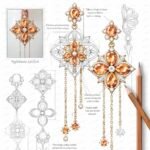
In the vast starry sky of jewelry design, the eternal order of Classicism and the profound wisdom of Buddhism converge like two ancient rivers, meeting here to form a brilliant, adorned cosmos. Here, jewelry ceases to be mere ornamentation; it becomes a miniature universe carrying the codes of millennia-old civilizations and the awakening of spirituality.
Chapter 1: Classical Order and Buddhist Emptiness
The Golden Ratio of ancient Greek temples, the minimalist glaze of Chinese Song porcelain, the precise symmetry of Indian mandalas—classical aesthetics pursue the eternal harmony and order of the cosmos. When this order encounters the Buddhist concept of “the emptiness of inherent existence,” a new design philosophy emerges: leaving blank spaces within rigorous structures, suggesting void within tangible forms.
One designer drew inspiration from the Dunhuang mural “The Jataka Tale of the Deer King,” yet instead of directly reproducing the scene, they condensed the compassionate instant of the nine-colored deer’s glance into the flowing contour of a brooch. Using the lost art of “filigree and inlay,” they created an artistic conception of “true emptiness and marvelous existence” on a K-gold base – metal filaments coiled into a deer shape, yet the center was boldly left empty, accented only by a single emerald, subtly aligning with the profound meaning of “form is emptiness.”
Chapter 2: The Cosmology of the Mandala and the Perspective of the Renaissance
The mandala is a cosmic map in Buddhism, a precise geometric poem. Its concentric structure and radial symmetry resonate wonderfully with the perspective principles of the Renaissance. A designer fused the mandala structure from Thangka paintings with Brunelleschi’s perspective principles to create a rotating, openable pendant –
The outer layer features Renaissance-style acanthus leaf gold carving, the middle layer is an eight-petaled lotus inlaid with sapphires, and the core is an uncut raw diamond, symbolizing the original face “seeing one’s true nature.” As the three-layer structure slowly rotates in the wearer’s hand, it resembles the completion of a contemplative practice, echoing the harmonious state of “a world in a flower” from the Avatamsaka Sutra.
Chapter 3: Contemporary Translation of the Seven Buddhist Treasures and Classical Metalwork
The luminous white of conch shell, the layered bands of agate, the transparency of crystal—the Seven Buddhist Treasures are reborn in contemporary design. One artisan studied the Tang Dynasty “pingtuo” gold and silver technique, slicing conch shell into 0.1-millimeter thin pieces and inlaying a micro-engraved Heart Sutra onto a black lacquer base. As light passes through the layered mother-of-pearl, the sutra’s text appears and disappears intermittently, requiring a calm and focused mind to decipher—the entire appreciation process itself becomes a form of Zen meditation.
Chapter 4: Dialogue Between Ritual Implements and Ergonomics
From the full curves of relic vases to the rotating dynamics of prayer wheels, the formal wisdom of Buddhist ritual implements is ingeniously transformed. A ring series based on the vajra prototype alters the traditional symmetrical form into an asymmetrical streamline, preserving the sacred feel of the implement while perfectly conforming to the flexion and extension of the modern finger. When the wearer rotates the ring shank, a hidden mechanism emits a clear, soft bell sound, miniaturizing the soundscape of temple wind chimes within a tiny space.
Chapter 5: The Beauty of Impermanence and the Revival of Ancient, Unrefined Craftsmanship
Buddhism perceives “impermanence” as beauty, and classical aesthetics also include crafts like “maki-e” and “kintsugi” that honor brokenness. This inspires designers to consciously leave room for “imperfection” in their creations: employing the ancient “tsuchi-oki kinko” (hammer-raising metalwork) technique ensures each piece’s hammer marks are unique; intentionally preserving the oxidation traces from the metal forging process is like respecting every wrinkle in life’s journey.
Epilogue: Perceiving the Five Aggregates as Empty, Overcoming All Aesthetic Suffering
The deepest design inspiration often comes from moments of contemplating one’s own mind. When a designer observes the trailing path of incense smoke during morning meditation, the curve of a necklace is born; when touching the paper texture of ancient scriptures and contemplating “all conditioned things are impermanent,” special textures for surface treatment emerge.
These jewels that fuse Classicism and Buddhism are not just bodily accessories but also methods for mental cultivation. They remind every wearer: the most precious gemstone is not in the mines, but within our intrinsic nature; the most exquisite craftsmanship is none other than using focused dedication to polish each moment of awakened awareness.
As a master artisan, upon completing a legacy piece, personally chiseled a hidden mantra: “It comes from the hand, yet responds to the heart. Dare I ask, is this jewelry, or is this the Dharma?” This, perhaps, is the highest realm of design—allowing matter and spirit to achieve ultimate harmony within a tiny space.